
Israel-Palestine Conflict 2025: Essential Facts You Need to Know Today

Israel and Palestine's situation has reshaped the scene into an "endless horror story" since the ceasefire agreement collapsed three weeks ago. Israel's attacks on Syria and its expanding Syrian territory occupation have caused regional tensions to rise steadily.
The International Criminal Court, backed by 125 member states, retains control to prosecute serious crimes under the Rome Statute as of April 2025. Diplomatic efforts continue actively. Iran's foreign minister has confirmed talks with the US through Oman indirectly, while Israel's attack on Palestine intensifies today.
Let's get into the major events' timeline and analyze the military situation now. We need to understand the humanitarian crisis deeply. This analysis will cover international legal proceedings and diplomatic responses that shape this conflict.
Timeline of Major Events in the 2025 Conflict
The January 2025 diplomatic agreement between Israel and Hamas became the most important turning point in the conflict. This ceasefire started on January 19 and helped exchange hostages and prisoners while humanitarian aid surged into Gaza. Hamas released 33 Israeli hostages and received nearly 2,000 Palestinian prisoners from Israeli jails during this period.
The collapse of the ceasefire agreement
Israel broke the two-month ceasefire on March 18, 2025, with one of the heaviest bombing campaigns in Gaza since the conflict began. The offensive killed more than 400 Palestinians and left over 500 wounded on just the first day. Multiple sources confirmed that Israel violated the January agreement terms. The agreement required both sides to begin talks about permanently ending the war on day 16 of the ceasefire.
Israel skipped these negotiations and demanded more hostage releases before discussing war-ending talks. They imposed a complete blockade on Gaza starting March 2 to pressure Hamas. Israeli Defense Minister Israel Katz later declared that "Israel will, from now on, act against Hamas with increasing military strength". Hamas called this action "a unilateral cancelation of the ceasefire" that left prisoners in Gaza facing "an unknown fate".
Israel's military operations in Gaza
Israel expanded its military operations dramatically after breaking the ceasefire. Defense Minister Katz announced on April 2, 2025, that troops would "widen their operation in Gaza to clear out militants and infrastructure and seize large areas that will be added to the security zones of the state of Israel". These operations included:
- Establishing the "Morag Axis" between Rafah and Khan Younis
- Securing the "Philadelphi Corridor" along the Egypt border
- Controlling the Netzarim corridor that cuts off northern Gaza
- Encircling the Tel al-Sultan area near Rafah
Prime Minister Netanyahu explained this strategy as "dividing the Strip and increasing the pressure step by step". Much of Gaza - about 64% - fell under active forced displacement orders or within Israel's "buffer zone" by early April. This expanded well beyond the 17% of Gaza that Israel had already marked as a buffer zone before these operations.
Key attacks and casualties
The renewed conflict brought devastating casualties. UN Secretary-General António Guterres reported that over 1,000 Palestinians died between March 18 and early April. The Gaza Health Ministry confirmed that Palestinian deaths exceeded 50,000 since October 2023 by April 8, 2025.
Several attacks stood out for their severity:
- On March 18: 404 Palestinians died, including 170 children and 80 women
- On March 23: An Israeli attack killed 15 humanitarian workers in a medical convoy
- On April 2: A strike on a UN refugee shelter in Jabaliya killed 19 people, including 9 children
- On April 8: At least 58 Palestinians died and 213 suffered injuries in 24 hours
The April 2 attack on a UN facility in northern Gaza proved especially tragic. The facility sheltered over 700 displaced people. UNRWA Commissioner-General Philippe Lazzarini reported that the dead included "nine children, including a two-week-old baby".
Israeli military operations reached beyond Gaza. Israel launched strikes in Lebanon and Syria, including an attack on a Hezbollah commander in Beirut. Israel's domestic intelligence service head Ronen Bar confirmed "a direct link" between operations in Gaza and these regional strikes.
Egypt and Qatar have stepped up their efforts to restart peace negotiations since the ceasefire collapsed, but military operations continue to grow with little success in peace talks.
Current Military Situation and Israel Attack on Palestine Today
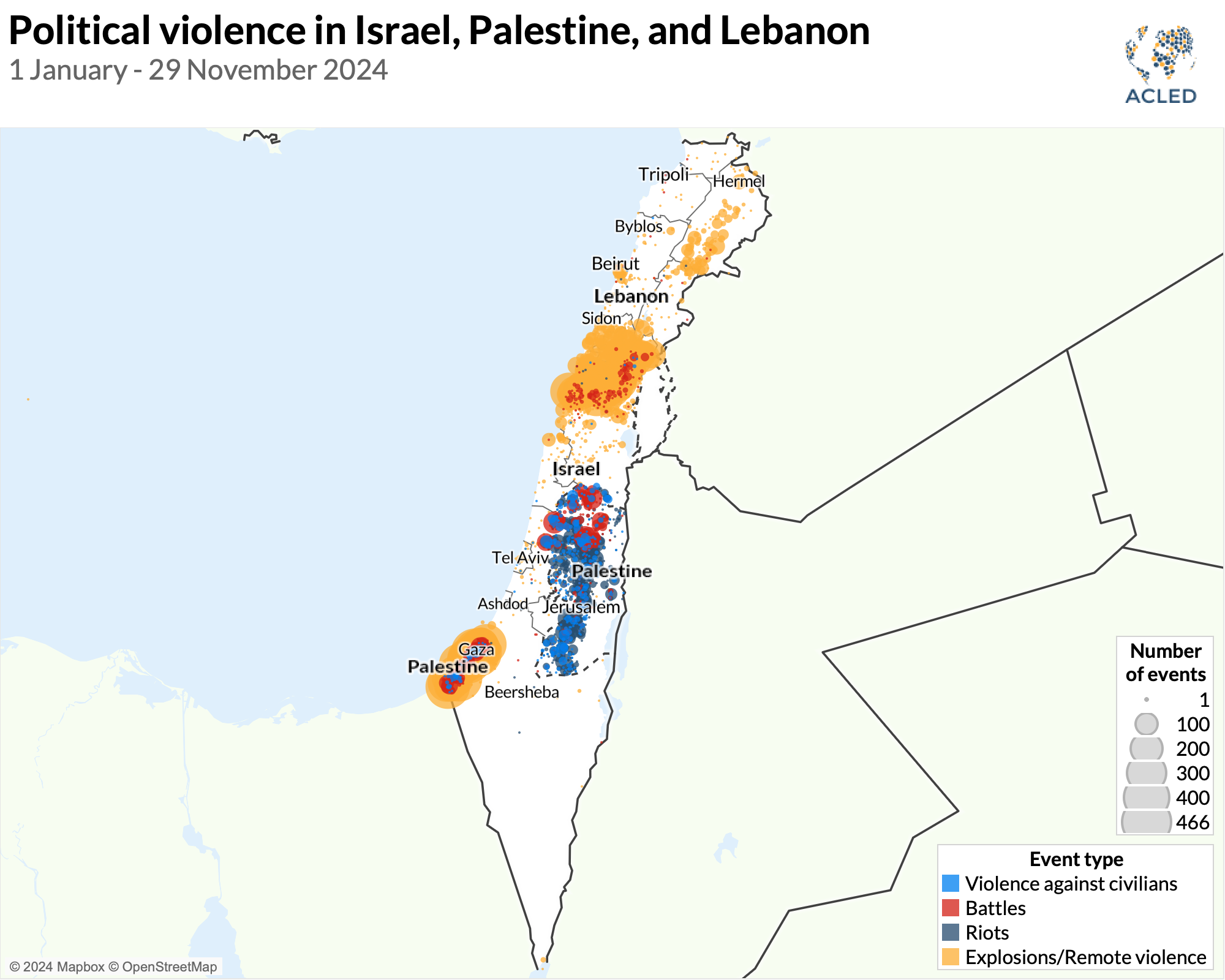
Image Source: acled
Palestinian health officials report that Israel's military campaign in Gaza has grown more intense in April 2025. The last 24 hours saw at least 58 people dead and 213 injured. These numbers add to the devastating toll since the war started: 50,695 Palestinians killed and 115,338 wounded.
Active conflict zones
Palestinians can't access nearly two-thirds of Gaza now. The Israeli military has turned 64% of the territory into restricted areas through forced displacement orders and buffer zones [25,28].
Combat operations rage throughout Gaza. Israeli forces have started a new offensive near Jabalia refugee camp in the north. They target Hamas militants who started regrouping in that area. This operation turned deadly when a strike hit a UNRWA clinic that sheltered displaced people, killing 19 people, including nine children.
The fighting in Central Gaza has become fierce. Israeli forces told Palestinians to leave several neighborhoods in Deir al-Balah after projectiles were fired from Gaza. Israeli shelling also killed at least four people in the Jabaliya refugee camp up north.
Southern Gaza faces severe attacks. Israeli forces now surround the Tel al-Sultan area near Rafah. Military statements claim dozens of militants died in the operation. Palestinian radio reports that people have left the Rafah area almost completely after evacuation orders.
Types of weapons being used
Israeli forces use these weapons in Gaza:
- Heavy aerial bombs: US-made 2,000-pound MK-84 bombs that create massive craters characteristic of delayed fuse detonations
- Precision munitions: GBU-39 "small diameter" 250-pound bombs fitted with guidance systems
- Artillery shells: 155mm artillery rounds, with over 100,000 reportedly fired during the first 40 days of ground invasion
- Armored vehicles: Including US-made David light armored vehicles delivered to Israel
The United States has approved $7.40 billion in bombs, missiles and related equipment sales to Israel. The U.S. will also send Israel 20,000 assault rifles that the Biden administration had delayed earlier.
Israeli forces use these weapons extensively in populated areas. Their operations combine armored columns with heavy artillery and air strikes. Military bulldozers and combat engineers have damaged or destroyed 63 percent of Gaza's buildings.
Strategic objectives of military operations
Defense Minister Israel Katz announced a major expansion of military operations on April 2. He declared that Israel would seize "large areas" and add them to Israeli security zones. Prime Minister Netanyahu emphasized taking the "Morag Axis" between Rafah and Khan Younis to create a "second Philadelphi Corridor".
This strategy serves multiple purposes. Netanyahu stated they want to divide the strip and increase pressure gradually. The military also wants to stop Hamas from getting external supplies or reinforcements.
The Israeli military has created two important corridors. One cuts northern Gaza from the south, which stops Hamas forces in the south from helping those in the north. The Philadelphi corridor along the Egypt border blocks Hamas from getting outside help.
Israel has succeeded in destroying Hamas' military capabilities. Critics say this military success hasn't translated into political victory that removes Hamas from power. Israeli leaders plan to help Palestinians leave Gaza "voluntarily". This raises serious concerns about permanent displacement and possible ethnic cleansing.
Humanitarian Crisis in Gaza and the West Bank
The humanitarian crisis in Gaza has reached catastrophic levels in 2025. Palestinian civilians now face unimaginable suffering due to Israel's military campaign.
Civilian casualty statistics
Gaza's Health Ministry reports that over 50,000 Palestinians have died and more than 114,000 suffered injuries since October 2023. Children under 18 make up 31% of those with confirmed identities. The Lancet's peer-reviewed analysis shows death counts from traumatic injuries were 41% lower than actual figures during the war's first nine months. UN Human Rights Office investigations reveal that women and children account for about 70% of Palestinian deaths. A Palestinian survey indicates that over 60% of Gazans have lost family members in the ongoing war.
Displacement of Palestinians
The war has forced nearly 1.9 million people—90% of Gaza's population—from their homes. Some residents have had to move up to 10 times. Israel has issued ten mandatory evacuation orders covering major areas in all governorates since mid-March 2025. These evacuations violate international humanitarian law because Israel provides neither accommodation nor adequate conditions for evacuees.
The crisis affects the West Bank too. Operation "Iron Wall," which began in January 2025, has displaced about 40,000 Palestinians—the largest such movement since 1967.
Medical infrastructure damage
Gaza's healthcare system lies in ruins. Only 16 of 36 hospitals work partially, with just 1,822 beds available—nowhere near enough for the current medical emergency. WHO has documented 654 attacks on healthcare facilities that killed 886 people. The targeting of medical staff has resulted in over 1,000 healthcare worker deaths since October 2023.
Food and water security issues
Israel's latest assault has made Gaza's food crisis worse. A humanitarian aid blockade started on March 2 and continues after three weeks. About 1.8 million people face "extremely critical" hunger levels, with 70% of crop fields destroyed. People now have less than 5 liters of water per day—just one-third of WHO's minimum survival requirement. Israel's March power cuts have left 600,000 people without drinking water access again, pushing Gaza deeper into humanitarian disaster.
International Legal Proceedings and Allegations
The legal consequences of the Israel-Palestine conflict reached new heights in 2025. International courts took unprecedented action against top leaders from both sides.
ICC investigations
The International Criminal Court (ICC) issued arrest warrants for Israeli Prime Minister Benjamin Netanyahu and former Defense Minister Yoav Gallant in November 2024. The judges found reasonable grounds to believe both officials were responsible for:
- War crimes including starvation as a method of warfare
- Crimes against humanity including murder and persecution
The ICC also issued a warrant for Hamas military wing commander Mohammed Deif for war crimes and crimes against humanity committed on October 7, 2023. Israel claimed the ICC lacks jurisdiction, but the court confirmed in February 2021 that its authority extends to Gaza and the West Bank.
War crimes complaints
South Africa's case at the International Court of Justice (ICJ) against Israel for violations of the Genocide Convention led to three binding provisional measures since January 2024. Israel has ignored the court's orders to open border crossings and allow humanitarian aid into Gaza at scale.
The UN Commission of Inquiry found "clear evidence" of war crimes in Gaza. The commission pointed to a "concerted policy to destroy Gaza's healthcare system" that amounts to the crime of extermination. ICC Prosecutor Karim Khan stated that Israel has made "no real effort" to investigate these allegations.
Legal status of occupied territories
A major ICJ advisory opinion in July 2024 declared Israel's presence in Palestinian territory "unlawful". The court ruled that Israel must "evacuate and dismantle all settlements" and provide reparations to Palestinians. UN High Commissioner for Human Rights Volker Türk stressed that "Israel's settlement policy, its acts of annexation, and related discriminatory legislation and measures are in breach of international law".
Violations of international humanitarian law
Israeli forces allegedly committed many violations of international humanitarian law during the 2025 conflict. Human Rights Watch documented Israeli military forces causing "deaths and unnecessary suffering of Palestinian patients while occupying hospitals". UN experts determined that Israel's actions of "systematically destroying women's healthcare facilities" and imposing measures "intended to prevent births" qualify as genocidal acts.
Israel reimposed a complete siege on Gaza in March 2025. The UN labeled this blockade of humanitarian aid as "collective punishment" – which constitutes a war crime under international law.
Global and Regional Diplomatic Responses

Image Source: CNN
Diplomatic efforts around Israel have gained momentum after the January ceasefire collapsed. This revealed significant rifts among international leaders.
US position and involvement
The Trump administration stands firmly with Israel. White House Press Secretary Karoline Leavitt confirmed Israel consulted them before attacking Palestine today. "President Trump has made it clear, Hamas, the Houthis, Iran, all those who seek to terrorize not just Israel but also the United States of America will see a price to pay," she stated. America's UN ambassador placed the blame "solely with Hamas" and backed Israel's military actions fully.
Middle Eastern nations' stances
Arab states proposed a different path through their Recovery and Reconstruction Plan for Gaza. The League of Arab States endorsed this $53 billion five-year plan in March to rebuild Gaza while protecting civilians. Qatar, Egypt, and Saudi Arabia have voiced strong opposition to Israel's military operations. Qatar's Foreign Ministry warned that Israel's "escalating policies will ended up ignite the region."
European diplomatic initiatives
European leaders chose a balanced approach. Foreign Ministers from France, Germany, Italy, and the UK released a joint statement that welcomed the Arab initiative. They stressed that "Hamas must neither govern Gaza nor be a threat to Israel anymore." Germany noted that "the images of burning tents in refugee camps are shocking." Belgium called Israel's attacks "a serious violation of international law."
UN resolutions and actions
UN Secretary-General António Guterres expressed shock at Israel's attacks that killed "a meaningful number of civilians." The Security Council hasn't dealt very well with the conflict because some permanent members vetoed resolutions against Israel. Special Coordinator Sigrid Kaag emphasized that "a sustainable resolution" needs political courage from everyone involved. She stressed that "peace in the Middle East is possible."
Conclusion
The Israel-Palestine conflict has reached its worst levels of destruction in 2025. January's ceasefire brought a glimmer of hope, but its breakdown led to devastating results. Israeli forces now control 64% of Gaza. Palestinian deaths are a big deal as they mean that 50,000 people have lost their lives, while two million residents have fled their homes.
The ICC is investigating war crimes on both sides as legal pressures grow. Aid organizations can't even provide simple necessities anymore. Hospitals have fallen apart and people don't have enough food to survive. Qatar and Egypt keep trying to broker peace, but success remains limited.
This crisis just needs the world to act now. The US still backs Israel strongly, but European countries have taken a more balanced position. They want Hamas gone while protecting civilians. Arab nations have proposed a $53 billion Recovery and Reconstruction Plan that could help, but ongoing military operations make it hard to implement.
This crisis won't end unless all sides change their approach drastically. The toll on civilian lives and destruction of strong infrastructure will



.jpg)

0 Comments